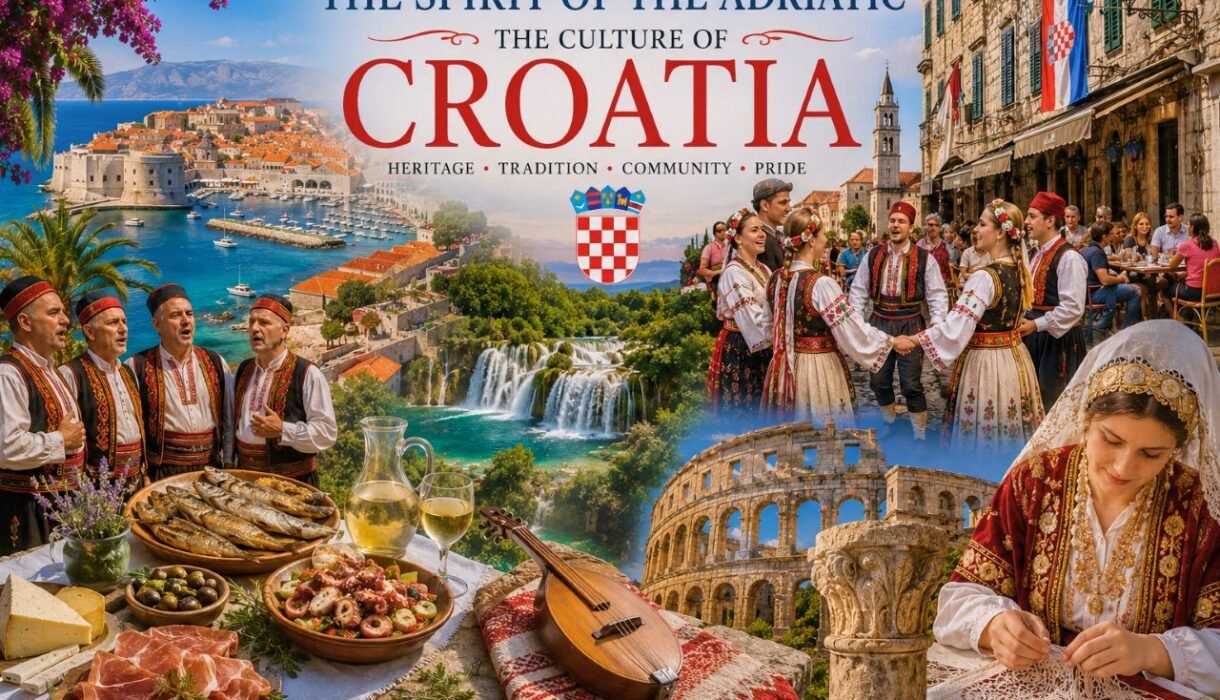

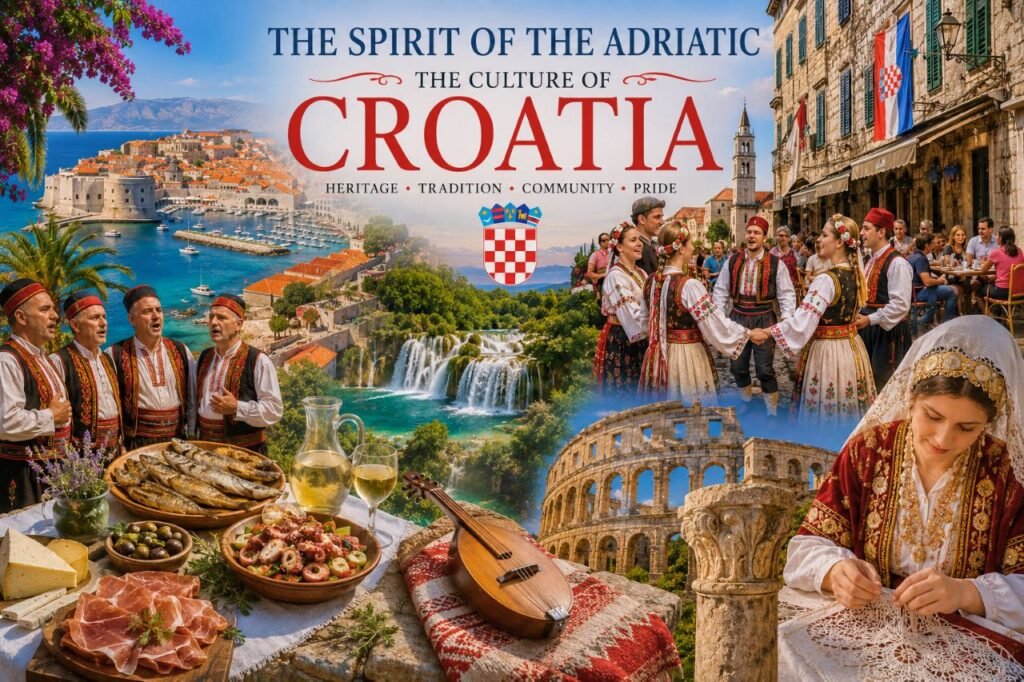
Positioned on the scenic borderlands where Central Europe dips into the sun-drenched Mediterranean, Croatia (Hrvatska) possesses a culture shaped by geographical beauty and deep historic transitions. The Croatian people (Hrvati) are the proud custodians of a cultural inheritance that gracefully blends Roman sophistication, Venetian maritime artistry, Austro-Hungarian elegance, and ancient Slavic traditions.
Whether walking along monumental seaside stone fortifications, listening to spontaneous acapella harmony in a village square, or taking part in centuries-old highland carnivals, Croatia reveals a lifestyle that balances historical pride with relaxed coastal living. It is a nation that has mastered the Mediterranean art of slowing down, placing family connections, culinary craftsmanship, and local community at the absolute core of daily life.
History & Origins
Croatia’s history is an enduring story of survival, maritime dominion, and structural synthesis at the geopolitical crossroads of empires.
[Slavic Migrations 7th C.]➔[Independent Medieval Croatian Kingdom]➔[Personal Union with Hungary]➔[Habsburg & Venetian Partition]➔[Yugoslav Era]➔[Sovereign Democratic Republic]
- Ancient Foundations and Slavic Roots: Long before the Slavs arrived in the 7th century, the region was an important province of the Roman Empire, leaving behind monumental structures like Diocletian’s Palace in Split. In 925 AD, Tomislav became the first crowned King of the Croats, forging a powerful medieval kingdom that successfully balanced independence between Western Rome and Byzantine Constantinople.
- The Split Identity: By the 12th century, Croatia entered a personal dynastic union with Hungary. For centuries, the territory was divided: the continental interior aligned with the Central European Austro-Hungarian Habsburg Empire, while the stunning Dalmatian coastline came under the maritime commercial control of the Republic of Venice. Concurrently, the independent Republic of Ragusa (modern-day Dubrovnik) flourished as a global hub of maritime trade and diplomacy.
- The Modern Rebirth: Following the collapse of the empires after World War I, Croatia was integrated into the Kingdom of Yugoslavia, and later, the Socialist Federal Republic of Yugoslavia. In 1991, the nation declared independence, successfully defending its sovereignty through a challenging four-year Homeland War. Today, Croatia stands as a prosperous, modern democratic state fully integrated into the European Union and the Eurozone.
Culture, Traditions & Customs
Marriage & Family Milestones
Family forms the unbreakable core of Croatian social life, with generations often living in close proximity. Traditional Croatian weddings (svadba) are energetic, emotional events that frequently run until dawn. A popular coastal tradition involves the Barjaktar (flag-bearer), a charismatic wedding leader who carries the national flag at the front of the wedding procession, orchestrating songs and good-natured disruptions on the way to the church. In naming ceremonies, newborns are frequently named after grandparents or regional patron saints, anchoring the child to family history.
Festivals & Folklore Rites
- The Sinjska Alka: Held every August in the town of Sinj since 1715, this magnificent, UNESCO-listed equestrian tournament commemorates a historic victory over Ottoman forces. Elite local horsemen ride at full gallop, aiming their long lances at a small, suspended iron ring called the Alka to win points and local honor.
- The Bell Ringers of Kastav: During the winter carnival season, groups of men dress in sheepskins with massive cowbells strapped to their backs, wearing stylized animal masks. They march rhythmically from village to village to drive away evil winter spirits and awaken the spring soil.
Languages & Communication
The official language is Croatian (Hrvatski jezik), a South Slavic language that serves as a core pillar of national identity.
Linguistic Identity and Regional Dialects
Croatian uses the Latin alphabet. Historically, it was unique for using the Glagolitic script—the oldest known Slavic alphabet—well into the 19th century, preserved on stone monuments like the Baška Tablet. The language is split into three major regional dialects based on the local word for “what”:
- Štokavian: The basis for the standard literary language.
- Kajkavian: Spoken in the northern continental areas, sharing features with Slovenian.
- Čakavian: Spoken along the Dalmatian coast and islands, heavily enriched with Italian maritime vocabulary.
Cultural Communication Style
Croatians are naturally expressive, direct, and conversational. Communication along the coast is lively and mimics Mediterranean styles, while the continental interior leans toward Central European formality.
- “Sve u svoje vrijeme.”
Translation: “Everything in its own time.” This popular proverb reflects the deeply rooted national belief in patience and letting events unfold naturally.
Geography
Croatia features a distinctive crescent or horseshoe shape, dividing its geography into two completely distinct natural zones:
The Continental Interior
The northern plains and rolling hills are defined by a lush Central European landscape. This fertile agricultural zone is shaped by major river networks like the Sava and Drava, and is home to the capital city, Zagreb.
The Karst and Adriatic Coast
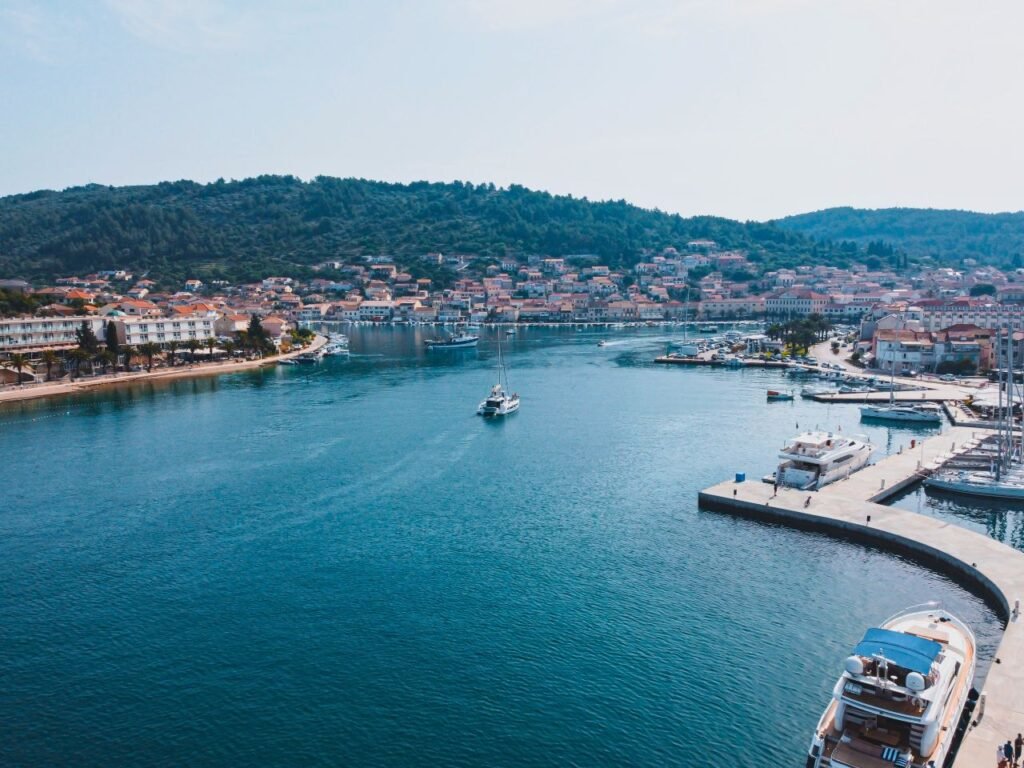
The rugged Dinaric Alps form a limestone wall separating the interior from one of the world’s most spectacular coastlines. The Adriatic coast features over 1,200 islands, islets, and crags surrounded by exceptionally clear, azure waters. This zone also includes the famous Plitvice Lakes National Park, a cascading network of sixteen interconnected terrace lakes carved through natural travertine limestone dams.
Economy
Croatia operates an advanced, service-based market economy. While traditional manufacturing, shipbuilding, pharmaceuticals, and agricultural processing remain important industrial foundations, the undisputed engine of modern economic growth is coastal tourism.
The country draws millions of international visitors annually to its ancient Roman ruins, pristine national parks, and medieval coastal towns. Additionally, Croatia has emerged as a high-tech destination, notably producing world-class components in the electric vehicle sector through innovative native firms like Rimac Automobili.
Politics
Croatia is a democratic parliamentary republic. The head of government is the Prime Minister, who holds executive power and leads the government cabinet, which must maintain a working majority within the unicameral parliament (Hrvatski sabor).
The head of state is the President, who is elected directly by popular vote to serve a five-year term, performing representative functions and overseeing foreign policy alongside the military command. The nation joined NATO in 2009 and became a member of the European Union in 2013, later joining both the Schengen Area and the Eurozone.
Ethnic Groups
The population displays a high degree of cultural continuity, with roughly 91% identifying as ethnically Croatian.
The largest historical minority community is the Serb population (around 3.2%), located primarily in the inland border regions. The remaining demographic landscape includes small, vibrant minority communities of Italians (settled mostly in Istria), Bosniaks, Hungarians, Slovenes, Czechs, and Roma, all of whom enjoy constitutionally protected cultural preservation and political representation.
Beliefs & Values
Religious Identity
Spirituality in Croatia is deeply intertwined with Roman Catholicism, which encompasses approximately 79% of the population. For centuries, the Catholic Church functioned as a crucial institutional shield, preserving the Croatian language, history, and European identity through periods of foreign partition and ideological change. Eastern Orthodox Christianity and Islam represent the largest minority religious groups.
Fika, Fjaka, and Social Values
The primary social value across Croatia is the preservation of personal relationships. This is perfectly illustrated by the daily ritual of spending hours talking over a single small cup of coffee at a local outdoor café.
Along the Dalmatian coast, this mindset deepens into Fjaka—a sublime, psychophysical state of absolute relaxation, where the mind and body enter a meditative rest, completely free from the pressures of work or scheduling.
Food & Cuisine
Croatian cuisine (Hrvatska kuhinja) is beautifully divided into two distinct culinary traditions, reflecting the country’s dual geographic identity.
Coastal Mediterranean Gastronomy
The cuisine of Istria and Dalmatia relies on fresh seafood, wild herbs, garlic, and high-quality olive oil. Signature dishes include Crni Rižot (a rich squid ink risotto) and fresh fish grilled simply over grapevine embers. Istria is also globally famous for its rare white and black truffles.
Continental Central European Fare
The inland culinary style focuses on hearty meats, stews, and root vegetables. Iconic dishes include štrukli (delicate pulled pastry filled with fresh cottage cheese and baked with cream) and slow-roasted turkey served with mlinci (traditional flatbread noodles).
The Ritual of the Peka
The ultimate culinary tradition connecting both zones is Peka. This slow-cooking method places lamb, veal, or octopus alongside potatoes and herbs inside a shallow round iron tray. A heavy, bell-shaped iron lid is placed on top, which is then completely covered in live charcoal embers, allowing the ingredients to roast slowly in their own juices for hours.
Clothing & Symbols
The Tie: Croatia’s Gift to Global Fashion
The most famous cultural symbol exported by Croatia is the Cravat (the necktie). In the 1630s, Croatian mercenary soldiers serving in the French army wore distinctive, brightly colored neckerchiefs knotted around their collars. King Louis XIV was so taken by the elegant look that he adopted it into royal court attire, naming it a cravate (a French mispronunciation of “Croat”), which eventually evolved into the modern men’s necktie.
Traditional Attire
Traditional Croatian folk costumes (narodna nošnja) vary significantly by valley and region. Continental costumes feature complex white linen shirts decorated with red geometric embroidery and lace.
Coastal styles use elegant, dark woolen dresses paired with delicate, hand-woven gold filigree jewelry. A common element across many regions is the Lika cap or red embroidered skullcaps, reflecting historic military frontiers.
Music, Dance & Art
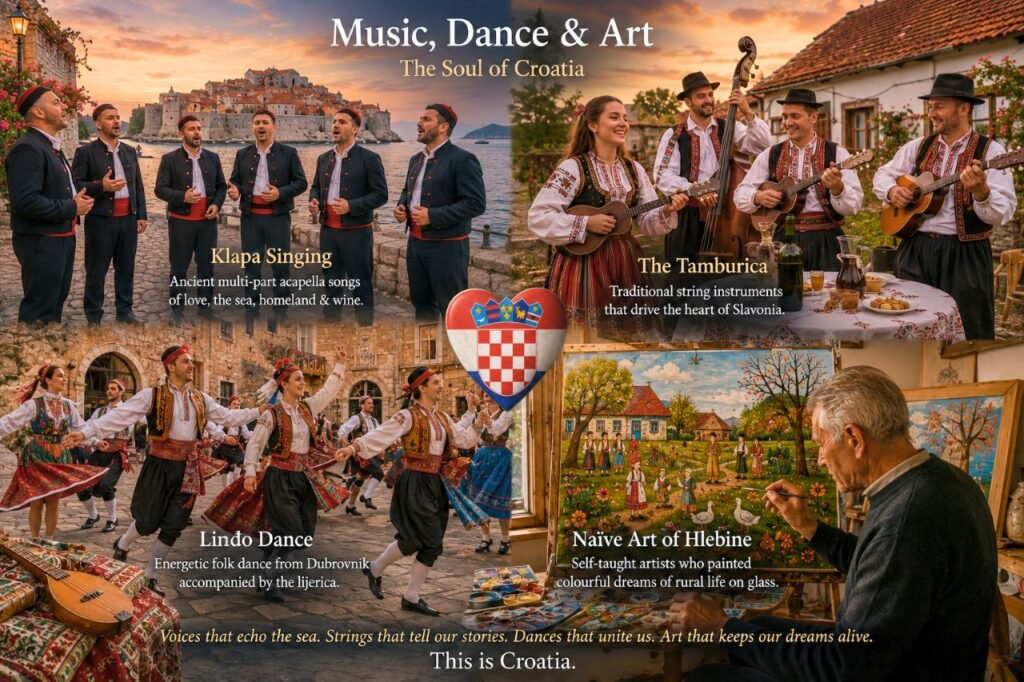
The soul of Croatia, music, dance, art
Klapa and the Tamburica
- Klapa Singing: Along the Dalmatian coast, men and women form small vocal groups to perform Klapa, an ancient style of multi-part acapella singing. These sentimental, unstructured songs focus on themes of love, the sea, homeland, and wine, producing an incredibly smooth polyphonic harmony.
- The Tamburica: In the continental plains of Slavonija, musical life revolves around the Tamburica, a traditional family of plucked stringed instruments similar to the mandolin, which anchors fast, energetic community songs.
Dance and Naïve Art
The national folk dance is the Linđo, an energetic, rhythmic dance from the Dubrovnik region accompanied by a traditional three-stringed instrument called the lijerica.
In the visual arts, Croatia pioneered Naïve Art during the 20th century, centered in the village of Hlebine. This internationally acclaimed style featured self-taught peasant painters who created rich, dreamlike oil paintings directly on panes of glass, capturing rural life with vibrant detail and emotional depth.
Summary
The culture of Croatia stands as a brilliant achievement in blending diverse European traditions into a unified national identity. By matching the structural organization of Central Europe with the artistic freedom and relaxed lifestyle of the Mediterranean, the Croatian people have cultivated a society defined by creative expression and deep resilience. From the ancient Glagolitic stone tablets to the polyphonic harmonies of coastal Klapa, Croatia continues to offer a cultural landscape where history is deeply honored, nature is preserved, and life is celebrated at an unhurried, graceful pace.
At Best Culture Insight, we see culture as the heartbeat of every society – the way people live, connect, and express their identity.