The Mosaic of Central America and the Caribbean: A Deep Journey Into Belize Culture
Posted in :

Nestled on the eastern coast of Central America, facing the azure waters of the Caribbean Sea, Belize stands as a breathtaking cultural bridge within North America. It is a nation uniquely blessed: physically anchored to the Central American mainland, yet historically, linguistically, and socially bound to the vibrant spirit of the Caribbean. – Belize culture
To step into Belize is to encounter a harmonious multi-ethnic tapestry where no single culture dominates; instead, diverse traditions intertwine seamlessly. The people of Belize, known universally as Belizeans, possess an exceptionally relaxed, warm, and hospitable worldview. Their national identity is an extraordinary living mosaic—a place where ancient Maya cities peer over lush rainforests, where the rhythmic drums of the Garifuna echo along coastal sands, and where Mestizo, Creole, Mennonite, and East Indian heritages form a unified, deeply resilient society.
History & Origins
The historical foundations of Belize are deep and complex. For centuries, the region was a vital heartland of the ancient Maya Civilization, housing majestic city-states like Caracol, Lamanai, and Xunantunich, which supported advanced systems of mathematics, astronomy, and agriculture. Following the mysterious decline of the Maya classic period and the arrival of European explorers, the territory became a geopolitical anomaly.
While Spain claimed the entire region, they largely neglected the dense reef systems and rugged coastline of Belize. This vacuum allowed British buccaneers (pirates), known historically as the Baymen, to settle the area in the 1600s. They shifted from piracy to the highly lucrative extraction of logwood and mahogany. To cut these massive timber trees, British settlers imported thousands of enslaved West Africans. This forced migration introduced complex linguistic, spiritual, and musical traditions that formed the foundation of the country’s Creole population.
The cultural fabric expanded significantly through successive waves of migration:

- The Mestizo Influx: In the mid-19th century, thousands of Mestizos (people of mixed Spanish and Maya descent) fled the brutal Caste War of Yucatán, seeking refuge in northern Belize and establishing thriving agricultural communities.
- The Garifuna Arrival: In 1832, the Garifuna people—descendants of shipwrecked West African individuals and indigenous Carib-Arawaks exiled from St. Vincent—arrived by dugout canoe on the southern coast, injecting an unbreakable Afro-indigenous heritage into the nation.
Formerly known as British Honduras, the colony peacefully achieved full political independence and officially took the name Belize on September 21, 1981, remaining a proud, democratic constitutional monarchy within the Commonwealth.
Culture, Traditions & Customs
Community Celebrations and Heritage Days
In Belizean society, family structure varies across ethnic groups but universally emphasizes community solidarity. Among the Creole and Garifuna, matrifocal households are common, with grandmothers acting as central cultural preservationists. Life milestones across all groups blend traditional Christian sacraments with energetic cultural expressions.
A highly unique national event is Garifuna Settlement Day, celebrated annually on November 19th. This national holiday commemorates the historic 1832 arrival of the Garifuna people on Belizean shores. At dawn, communities gather on the beaches of southern towns like Dangriga and Punta Gorda to witness dramatic re-enactments of their ancestors arriving in dugout canoes adorned with cassava leaves, followed by vibrant drumming, singing, and ancestral thanksgiving services.
The September Celebrations
The entire month of September is an explosive national festival season in Belize, marking two major historical events:
- The Battle of St. George’s Caye Day (September 10th): Commemorates the historic 1798 naval victory where British Baymen and enslaved Africans fought side-by-side to repel a Spanish invasion fleet, solidifying the territory’s British alignment.
- Independence Day (September 21st): The country erupts in spectacular patriotic parades, open-air jump-ups (street dances), and live musical events showcasing national unity.
Languages & Communication
Belize holds a highly distinct linguistic position as the only official English-speaking nation in Central America. English is the primary language used in government, legal courts, corporate commerce, and school systems. However, the authentic, everyday voice of the country is Belizean Creole (Kriol), an English-based creole language spoken universally across all ethnic groups as a unifying tongue.
Furthermore, due to its geographical positioning, Spanish is spoken fluently by over half the population, particularly in northern and western border towns. Additionally, Garifuna, Mopan Maya, and Q’eqchi’ Maya are proudly preserved and spoken within their respective communities.
Popular Belizean Kriol Expressions:
- “Gud mawnin! Weh di gwan?” – The standard, universal casual greeting meaning “Good morning! What’s going on?”
- “Fu chu?” – A short, common conversational expression meaning “Really?” or “Is that true?”
- “Fu baka” – An intensive idiomatic phrase meaning “In abundance” or “Too much.”
- “If yu waan hani, yu cyan bray di bee shak” – If you want honey, you cannot break the beehive (You must work patiently and respectfully to get the rewards you desire).
Geography
Belize features a highly diverse geographic landscape. The northern half consists of flat, limestone plains sliced by winding rivers and dedicated to sugarcane agriculture. In contrast, the southern and western interiors rise dramatically into the Maya Mountains, carpeted in dense subtropical rainforests, intricate limestone cave networks, and pristine wildlife sanctuaries.
[ The Natural Triad of Belize ] ┌─────────────────────────┬─────────────────────────┬─────────────────────────┐ │ The Coastal Lowlands │ The Tropical Jungle │ The Belize Barrier Reef│ │ Mangrove swamps, sandy │ Subtropical rainforests │ A 190-mile-long coral │ │ lagoons, and coastal │ housing ancient ruins & │ marvel featuring the │ │ fishing villages. │ diverse ecosystems. │ famous Great Blue Hole. │ └─────────────────────────┴─────────────────────────┴─────────────────────────┘The absolute crown jewel of the nation’s geography is the Belize Barrier Reef, a UNESCO World Heritage site stretching 190 miles along the coast. It is the second-largest barrier reef system in the world, punctuated by hundreds of low-lying islands called cays (pronounced “keys”), including Ambergris Caye and Caye Caulker, where a relaxed “Go Slow” lifestyle is passionately maintained.
Economy
The economic fabric of Belize has successfully evolved from its colonial timber-cutting days. Today, eco-tourism and sustainable international hospitality serve as the primary economic engine, drawing global travelers to its pristine marine reserves, diving hotspots like the Great Blue Hole, and ancient archaeological sites.
The second major pillar is agriculture, driven by the export of high-quality sugarcane, citrus concentrates, bananas, and farmed seafood. Additionally, local commercial fishing—particularly for Caribbean spiny lobster and conch—remains a vital livelihood for coastal communities.
Politics
Belize is a stable, independent parliamentary democracy. It is a constitutional monarchy where King Charles III serves as the head of state, represented locally by a Belizean Governor-General. Executive authority is held by the Prime Minister, who leads the cabinet and secures power as the head of the majority political party in the bicameral National Assembly.
Since gaining independence in 1981, Belize has maintained an exemplary democratic record, characterized by peaceful transitions of power between its major political parties and a strong national focus on conservation politics, environmental protection, and regional integration.
Ethnic Groups
Belize’s population is a model of multi-ethnic harmony, featuring a rich blend of ancestral heritages:
| Ethnic Group | Regional Heartlands | Cultural Legacy and Footprint |
| Mestizo | North (Corozal, Orange Walk) & West | People of mixed Spanish and Maya ancestry; brought deep traditions of agriculture, Spanish language, and marimba music. |
| Creole (Kriol) | Belize City & Central Regions | Descendants of British settlers and enslaved Africans; shaped the country’s national creole tongue, folklore, and political systems. |
| Maya (Mopan / Q’eqchi’) | South (Toledo) & West (Cayo) | Direct descendants of the ancient civilization; preserve ancestral languages, organic cacao farming, and textile arts. |
| Garifuna | South Coast (Dangriga, Seine Bight) | Afro-indigenous community; infused the nation with world-class percussion traditions, cassava cuisine, and UNESCO-recognized rituals. |
Note: Small but highly distinct communities of German-speaking Mennonites, East Indians, Chinese, and Lebanese merchants further enrich Belize’s unique social tapestry.
Beliefs & Values
The spiritual landscape of Belize is highly diverse but deeply grounded in Christianity. Roughly 40% of the population identifies as Roman Catholic (heavily influenced by Spanish and Mestizo history), while various Protestant denominations—including Pentecostal, Anglican, Seventh-day Adventist, and Mennonite congregations—make up a substantial 34%.
Religious values heavily guide public holiday calendars, civic morals, and community social structures. However, Belizean spirituality is uniquely tolerant, allowing ancestral systems to thrive alongside Christian theology:
- Garifuna Ancestral Devotion: The Garifuna practice the Dugu, a complex, multi-day spiritual ceremony led by a Buyei (shaman) that uses sacred drumming and dancing to commune with, heal, and honor the spirits of deceased ancestors (Gubida).
- Maya Worldview: Modern Maya communities maintain a deep reverence for the Earth, performing traditional agricultural blessing ceremonies before planting crops to appease the gods of rain and soil.
Food & Cuisine
Belizean cuisine is an aromatic, robust fusion of Caribbean spice and Central American corn-based traditions, creating an array of comforting national dishes.
The Everyday Staple: Rice and Beans
The absolute foundation of Belizean culinary life is Belizean Rice and Beans. Unlike other variations, here red kidney beans and long-grain white rice are cooked together in fresh, rich coconut milk, seasoned with recado paste, garlic, onions, and sweet peppers. It is traditionally served alongside stewed chicken, fried plantain slices (tajadas), and a fiery splash of local habanero pepper sauce.
Iconic Cultural Dishes
- Hudut: The definitive culinary masterpiece of the Garifuna. It features a fresh, whole fish simmered in a rich, deeply aromatic coconut broth infused with garlic, oregano, and local herbs. This savory soup is paired with a side of Fu-fu—green and ripe plantains boiled together and labor-intensively pounded in a large wooden mortar until they form a smooth, sweet, and heavy dumpling used to scoop up the broth.
- Chirmole (Black Dinner): A spectacular Mestizo soup known for its striking, jet-black appearance. The color comes from black recado, a savory paste made from charred local chilies and spices. The rich broth is slow-cooked with chicken pieces, hard-boiled eggs, and aromatic herbs, served steaming hot with fresh, hand-slapped corn tortillas.
- Fry Jacks: The quintessential Belizean breakfast item. These light, triangular pieces of flour dough are deep-fried until they puff up into golden, hollow pockets, eaten warm alongside refried beans, eggs, and local white cheese.
Clothing & Symbols
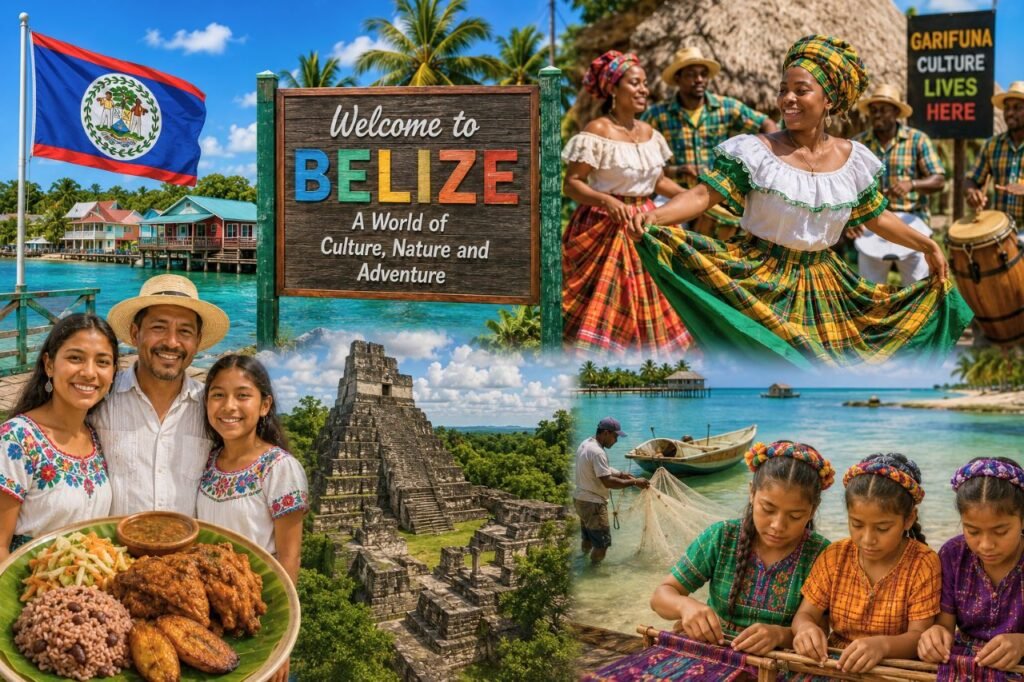
Exploring Belize culture, nature, adventure
Traditional Textiles and National Attire
In modern daily life, Belizeans wear standard contemporary Western clothing. However, during national heritage celebrations, traditional attire becomes a vibrant expression of identity. Mestizo women wear the elegant Huipil, a white cotton dress adorned with intricate, hand-embroidered floral patterns around the neckline, paired with a colorful rebozo shawl.
The Garifuna express their pride through clothing cut from Garifuna cloth—a traditional woven cotton fabric featuring vertical stripes of black, yellow, and white (the colors of their ethnic flag). Women fashion these into matching tiered dresses and beautifully knotted headwraps.
[ The Architecture of the Belize Flag ] ┌─────────────────────────┬─────────────────────────┬─────────────────────────┐ │ Top Red Bar │ The Center Blue Field │ Bottom Red Bar │ │ Added at independence to│ Represents the historic │ Added at independence to│ │ represent the unity and │ political identity and │ represent the unity and │ │ freedom of the nation. │ Caribbean sea basin. │ freedom of the nation. │ └─────────────────────────┴─────────────────────────┴─────────────────────────┘ [ Centerpiece: The National Coat of Arms ] Features a Mestizo and a Creole woodcutter standing beneath a mahogany tree, holding logging tools above the national motto: "Sub Umbra Floreo" (Under the shade I flourish), celebrating multi-ethnic unity and shared labor.The primary national symbol is The Mahogany Tree, which sits at the absolute center of the national flag. The Belize flag is globally unique for featuring human figures on its design. The central white disk depicts a Mestizo and a Creole woodcutter standing side-by-side beneath a mahogany tree, holding traditional logging tools. This imagery celebrates the historic multi-ethnic cooperation that built the nation under the inspiring Latin motto: “Sub Umbra Floreo” (Under the shade I flourish).
Music, Dance & Art
The Unstoppable Energy of Punta Rock
The sonic heartbeat of Belize is defined by the high-energy, infectious rhythms of Punta and Punta Rock. Traditional Punta is an ancestral Garifuna dance style driven by the polyrhythmic beats of twin Garawoun drums (large, hollowed-out hardwood drums topped with deer or peccary hide) and turtle shell shakers. The dance is a rapid, syncopated movement of the hips while the upper body remains relatively still.
In the late 20th century, pioneering Belizean musicians electrified this style, creating Punta Rock, which fuses traditional Garifuna drumming with electric guitars and synthesizers, turning it into the country’s most popular musical export.
[ The Instrumentation of Brukdown ] ┌─────────────────────────┬─────────────────────────┬─────────────────────────┐ │ The Accordion │ The Donkey Jawbone │ The Acoustic Guitar │ │ Leads the high-spirited,│ Scraped with a stick to │ Provides the rhythmic, │ │ nostalgic country folk │ create a unique, dry │ syncopated harmonic │ │ melodies. │ percussive rattle. │ backing. │ └─────────────────────────┴─────────────────────────┴─────────────────────────┘Simultaneously, Creole communities preserve Brukdown, an inventive folk music style born in rural logging camps. Brukdown features rustic accordion melodies driven by unique, improvised percussion instruments like the donkey jawbone (scraped with a stick to rattle the loose teeth).
Visual Arts and Craftsmanship
In the visual arts, Belizean creators use local hardwoods, limestone, and marine shells to craft stunning sculptures. Maya artisans continue to pass down ancestral basket weaving and pottery-making techniques, utilizing natural forest vines and organic clay slips to create intricate, functional art pieces that connect modern Belize to its ancient classic heritage.
Summary
The culture of Belize is an extraordinary testament to the beauty that emerges when a society chooses to celebrate, rather than suppress, its ethnic diversity. By successfully honoring ancient Maya monuments, preserving dynamic Garifuna drum rituals, and maintaining an infrastructure grounded in environmental conservation and peace, this Central American nation has carved out one of the most vibrant identities in North America. From the shared joy of a morning fry jack to the unifying, thunderous beat of a goatskin drum, Belize stands tall—proudly welcoming the world to experience its rich, warm, and profoundly diverse cultural heritage.
At Best Culture Insight, we see culture as the heartbeat of every society – the way people live, connect, and express their identity.