The Gerewol Festival — The World’s Most Beautiful Male Beauty Contest You’ve Never Heard Of
Posted in :

In most parts of the world, traditional beauty pageants feature women competing for crowns under bright studio lights. Deep in the Sahel region of West Africa, however, an ancient tradition flips this global standard on its head. Every September, at the end of the rainy season, the nomadic Wodaabe people gather in the Sahelian scrublands of Chad and Niger for the Gerewol Festival—a week-long courtship ritual where young men spend hours decorating themselves to be judged strictly by women.
The Wodaabe are a subgroup of the Fulani ethnic group known for their pastoral, migratory lifestyle and an intense cultural devotion to aesthetics. In Wodaabe society, beauty, charm, and physical elegance are considered essential virtues for both men and women. The Gerewol is not merely a social event; it is a vital annual gathering where dispersed clan lineages reunite, resolve internal disputes, arrange marriages, and celebrate the brief season of relative abundance when pastures are green and cattle are well-fed.
The Art of Extreme Male Decoration
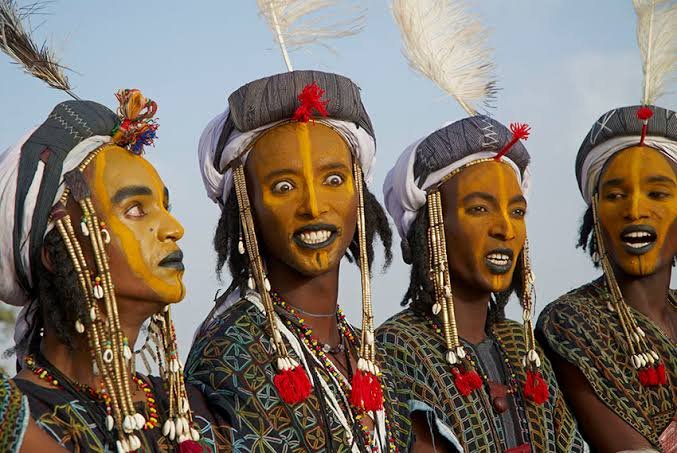
Preparation for the main courtship competition, known as the Yaake dance, requires meticulous artistic preparation. Young men dedicate up to six or seven hours every day transforming their appearance using natural minerals and plant dyes. They paint their faces with bright orange and red clay made from crushed rocks, apply white clay patterns to accentuate facial symmetry, and paint their lips black using charred plant matter to make their teeth appear extraordinarily white.
The attire worn during the dance is designed to exaggerate height, grace, and nobility. Competitors adorn themselves with long woven tunkins, intricate beadwork necklaces, cowrie shell ornaments, and tall white ostrich feathers fastened to colorful turbans. Every detail serves a distinct visual purpose: tall feathers add vertical height, long white stripes drawn down the bridge of the nose create the illusion of a slender facial structure, and bold geometric patterns emphasize pristine skin texture.
Decoding the Criteria of Wodaabe Male Beauty
Unlike modern western pageants that rely on judges scoring points on a clip board, the Wodaabe evaluate beauty according to strict cultural standards rooted in natural biology and elegance. The three primary physical traits judged during the Yaake are the whiteness of the eye sclera, the brightness and straightness of the teeth, and a high, straight nose bridge. Height, slender body proportions, and flawless skin are also crucial factors that signal good health and genetic vitality.
To demonstrate these features, dancers perform rhythmic routines under the intense desert sun for hours at a time. They wide-open their eyes, roll them in unison, and bare their teeth in prolonged, dramatic smiles. These expressive facial movements are not random theatrical displays; they allow the female judges to evaluate eye clarity, facial symmetry, and physical endurance under demanding climatic conditions.
Female Choice and Courtship Power Dynamics
What makes the Gerewol unique among global courtship traditions is the total authority granted to female judges. The official judges are usually three young women—often daughters of past winners—who stand at a respectful distance and observe the line of dancing men. With subtle gestures, such as a raised hand or a gentle point of a finger, a female judge selects the men she considers the most attractive and charismatic.
The social implications of these selections are profound within Wodaabe culture. A winning male gains immense prestige, respect, and romantic attention across the community. Women have complete autonomy in choosing their partners during the festival; a woman may choose a winner as a husband, or even a married woman may choose to spend a night or leave with a festival victor without social stigma, as Wodaabe culture grants high sexual agency to women.
Charm, Grace, and the Power of Togu
Beyond raw physical beauty, competitors are evaluated on an intangible quality known as togu. Roughly translated as charm, magnetic charisma, and expressive grace, togu is demonstrated through a man’s posture, singing voice, and fluidity of motion during the endurance dance. A man may possess perfect facial features, but without togu, he cannot win the admiration of the female judges or the wider crowd.
To maintain their energy through hours of continuous singing and dancing in high temperatures, participants drink a fermented herbal brew containing natural stimulants. As the drumming accelerates and the dust rises from the ground, the collective singing reaches a hypnotic rhythm, creating an extraordinary atmosphere that merges physical endurance, artistic performance, and spiritual expression.
Preserving a Rare Cultural Treasure
In a rapidly modernizing world, the Gerewol Festival remains one of the most remarkable living examples of indigenous cultural heritage. Because the Wodaabe move constantly across vast arid territories without permanent settlements, the festival serves as their primary institution for cultural transmission, social cohesion, and identity preservation.
While climate change, political instability in the Sahel, and economic pressures pose real challenges to the nomadic pastoral lifestyle, the Wodaabe continue to gather every autumn to honor their ancestors. The Gerewol stands as a breathtaking reminder of human diversity—a celebration where male grace is celebrated, female choice is absolute, and beauty is honored as an essential art form.