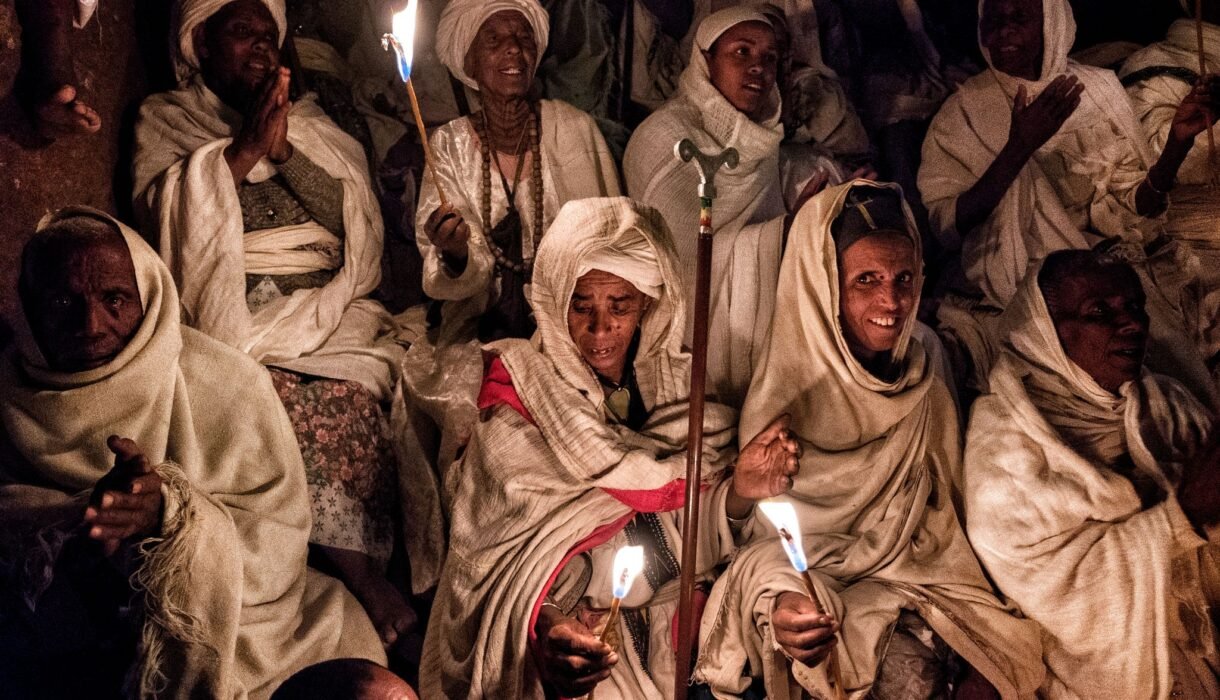
Why Ethiopians Celebrate Christmas on January 7 and New Year in September — and Are Right
Posted in :

While most of the world counts down to midnight on December 31st and unwraps Christmas gifts on December 25th, Ethiopia runs on a completely different rhythm. In this ancient East African nation, the New Year begins in September, and Christmas—known locally as Genna—is celebrated on January 7th. To modern travelers, this schedule might seem like an unusual delay. However, Ethiopia’s calendar is not an accidental lag; it is a meticulously preserved timekeeping system rooted in ancient history, astronomy, and biblical tradition.
A Time Machine in the Horn of Africa
When you land in Ethiopia, you do not just change time zones; you step back in time by roughly seven to eight years. Ethiopia operates on its own ancient calendar, known as the Ge’ez or Ethiopian calendar. Derived from the Coptic calendar of Egypt, it features 12 months of 30 days each, plus a unique 13th month called Pagume, which lasts five or six days depending on whether it is a leap year. Because of how it calculates the birth year of Jesus Christ, Ethiopia is constantly seven to eight years behind the standard Gregorian calendar used by most of the world.
The Great Calendar Split: Julian vs. Gregorian
To understand why Christmas falls on January 7th in Ethiopia, one must look at church history. Ethiopia maintained the ancient Julian calendar, which was established by Julius Caesar in 45 BCE. In 1582, Pope Gregory XIII introduced the Gregorian calendar to correct a slight mathematical error in the Julian system regarding solar years. While Western nations adopted the reform, the Ethiopian Orthodox Church—alongside several Eastern Orthodox traditions—retained the original system. In the Julian calendar, December 25th aligns precisely with January 7th on the modern Gregorian scale.
September: The Season of Harvest and Rebirth
Ethiopia’s New Year, called Enkutatash, falls on September 11th (or September 12th in leap years). Far from being an arbitrary date, September marks the end of the heavy rainy season in the Ethiopian highlands. The countryside bursts into bloom with bright yellow Adey Abeba daisies, the air clears, and farmers prepare to harvest their crops. Celebrating the New Year in September aligns human society directly with nature’s natural cycle of renewal, making it a far more logical time for a fresh start than the cold middle of winter in the Northern Hemisphere.
Historical Independence and Unbroken Continuity
Why didn’t Ethiopia simply change like everyone else? The answer lies in its fierce geopolitical independence. Ethiopia is one of the very few African nations that was never colonized by Western European powers. Because it maintained its sovereignty throughout the colonial era, European administrators never imposed the Gregorian calendar or Western civil structures on its institutions. Consequently, Ethiopia kept its historical calendar intact, preserving an unbroken cultural legacy that stretches back thousands of years.
Astronomical Accuracy and Biblical Calculation
The claim that Ethiopians “are right” comes down to how ancient scholars measured time. Early Christian theologians debated the exact year and date of Christ’s birth for centuries. Ethiopian scholars based their calculations on ancient astronomical observations and early Church tradition, placing the Annunciation four years earlier than Western church fathers did. Furthermore, their 13-month system avoids the awkward, uneven month lengths (28, 30, and 31 days) found in the Gregorian calendar, offering a clean, mathematically consistent 30-day base for every single month.
A Masterclass in Preserving Heritage
In our globalized world, standardized time can easily strip away local culture. Ethiopia’s adherence to its ancient calendar is a powerful testament to cultural pride, historical self-determination, and harmony with the natural environment. By celebrating Christmas in January and the New Year in September, Ethiopia isn’t late to the global party—it is simply holding fast to a logical, ancient, and deeply meaningful way of measuring life.