The “Tchiloli” Play of São Tomé — A Medieval European Drama Performed by Africans for 500 Years
Posted in :

Deep within the Gulf of Guinea, on the small island nation of São Tomé and Príncipe, lies one of the most remarkable performance traditions in world history. Known as Tchiloli (or Tragédia do Marquês de Mantua), this extraordinary theatrical ritual brings a 16th-century European court drama to life in tropical West Africa. For roughly five centuries, generation after generation of islanders have passed down this complex play, transforming a distant story of Renaissance kings into a uniquely African living ritual.
The Extraordinary Roots of a 500-Year Tradition
The origin of Tchiloli traces back to the Portuguese colonization of São Tomé in the late 15th and early 16th centuries. Portuguese settlers and sugar plantation owners brought European literary texts to the island, including a popular play written by the blind Madeira poet Baltasar Dias around 1540. The script was based on medieval European legends surrounding Emperor Charlemagne and his court of chivalric knights.
While European theatrical forms slowly faded or evolved in their homelands, the people of São Tomé adopted the text and made it their own. Over five centuries of enslavement, colonial rule, and ultimate independence, the islanders preserved the narrative line by line, ensuring that this Renaissance piece of political theater survived intact into the modern era.
A Story of Power, Treason, and Uncompromising Justice
At the core of Tchiloli is a tense legal drama about justice, accountability, and the rule of law. The plot centers on Dom Carloto, the prince and heir to Emperor Charlemagne’s throne. Driven by jealousy, Prince Carloto murders his best friend, Valdevinos, the nephew of the Marquis of Mantua, during a hunting trip in the forest.
When the crime is discovered, the Marquis demands justice for his slain nephew. However, the murderer is the Emperor’s own son. Emperor Charlemagne finds himself caught in a tragic dilemma: should he shield his child from punishment, or uphold the law equal for all subjects? Ultimately, Charlemagne chooses rule of law over personal bias, condemning his son to death—a striking storyline about holding powerful leaders accountable.
The Striking Fusion of European Dress and African Rhythm
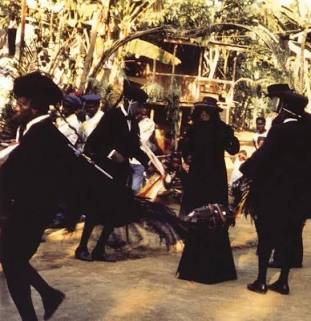
What makes a live performance of Tchiloli so striking is its vivid visual and auditory contrast. The actors—traditionally all male, fulfilling both male and female roles—wear elaborate, ceremonial costumes that merge European imperial style with African artistic design. Performers don dark suits, embroidered capes, silk ribbons, decorated velvet hats, and pale wooden masks that mimic European court facial features.
Yet, as the legal debates unfold, the rhythmic heartbeat of Africa takes total control of the performance space. European verse is accompanied by traditional West African bamboo flutes (pitos), iron gongs, and powerful hand drums (suco). The actors move in stylized, hypnotic dance steps across an outdoor dirt arena, turning a formal court trial into an energetic community event.
Subverting Colonial Rule Through Sacred Performance
For centuries under Portuguese rule, Tchiloli served as far more than mere entertainment; it was a clever tool of social commentary and resistance. Under the guise of performing a harmless, approved European play, African performers used Charlemagne’s story to critique local colonial authorities, corrupt judges, and abusive land bosses who operated above the law.
By staging a drama where even an Emperor must submit to justice, the people of São Tomé quietly asserted their own moral high ground. Furthermore, over time, the performance incorporated elements of ancestor veneration and local spiritual practices. To many islanders, putting on the mask is not just acting—it is inviting ancestral spirits to participate in communal healing and truth-telling.
Preserving a Living Masterpiece for Future Generations
Today, Tchiloli remains a central pillar of national identity in São Tomé and Príncipe. Local theater troupes (tragédias) operate within tight-knit village communities, passing down scripts, musical cues, and costume designs from father to son across generations. Each troupe maintains its own subtle variations, keeping the tradition vibrant and adaptable.
International scholars and cultural institutions recognize Tchiloli as a global treasure—a rare example of a early modern European drama preserved almost continuously in an African setting. It stands as proof of the power of art to cross ocean boundaries, adapt to difficult historical realities, and keep the spirit of justice alive.